Monday, 26 March 2012

Mooseloaf!


Given all the beef recalls we Canadians are currently subject to, I thought I’d play it safe last night. I whipped up a loaf made from the ground carcass of an entirely different animal.


As a child, meatloaf was the only food I ate with ketchup. As a rule I didn’t like either, but I forced them down together hoping that these two culinary wrongs would somehow make a right. They didn’t.

Nevertheless, now I’m older, wiser and cheaper, and I’ve had this free ground moosemeat sitting in my fridge for the last couple of months. I figure serving meat in a loaf is possibly the best way to appreciate all its carcinogenic goodness, so read on and enjoy!


I found a recipe the way anybody finds anything nowadays—through Google. One turned up on a Norwegian blog, as follows:


500 g ground moose meat
50 ml oats
100 ml cream
½ tablespoon potato starch
1 egg, beaten
1 tsp salt
½ tsp black pepper
1 ½ tsp ground cumin
1 garlic clove, pressed
2 Tbsp parsley, finely chopped


I replaced the cream with soy milk and the potato starch with nothing, seeing as I’ve never heard of it. I’m also not exactly sure how much meat I used—I held the meat in one hand and a 500 g bag of asparagus in the other, with roughly equal muscle strain in both arms, so there you go. The metric-to-imperial conversions were also approximate, but if you prefer a more scientific method you can do your own calculations here.


Now – it’s time to make some moose!
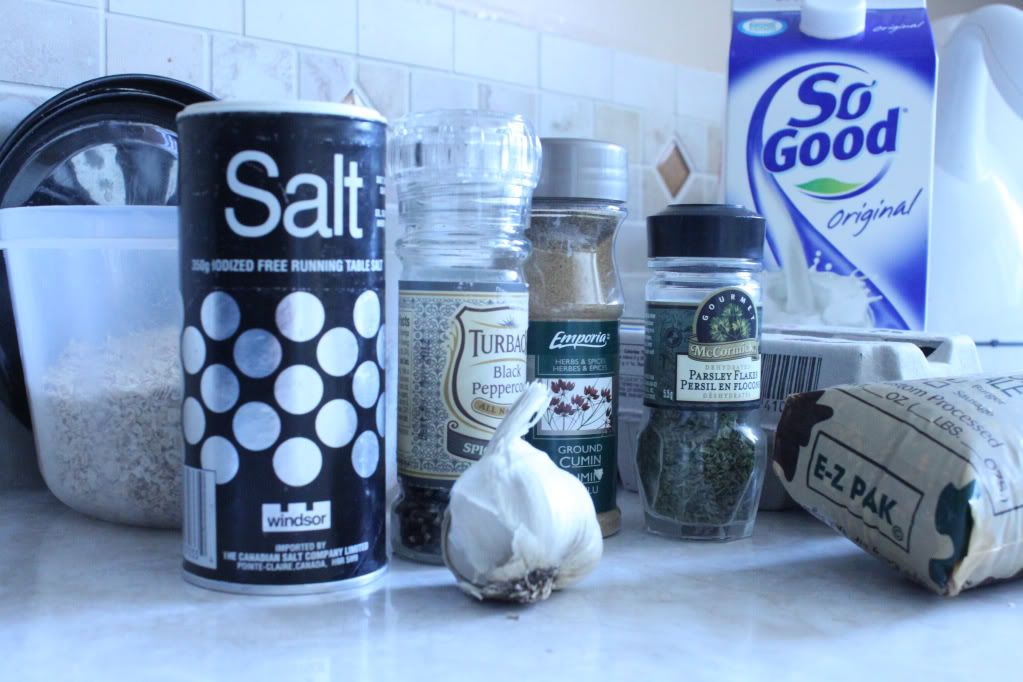
Here's what you'll need.
Step 1. In a large bowl, lightly beat the egg. Add everything except for the ground meat.

Step 2. Set aside for 5 minutes, then add ground meat and mix well.
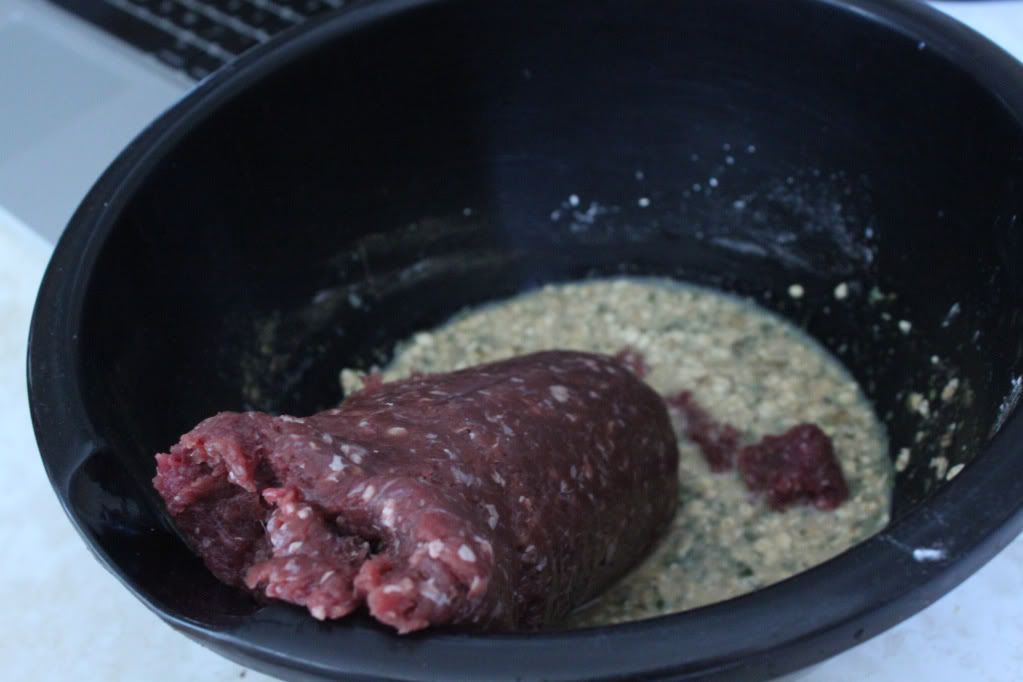
Mmmmm.
Step 3. Shape into a "loaf" shape.


Step 4. Bake on parchment paper [I used foil] lined baking sheet at 225°C [440°F] for about 30 - 40 minutes, or until juices run clear. [I’m paranoid about raw meat and I still took it out of the oven at 30 minutes].
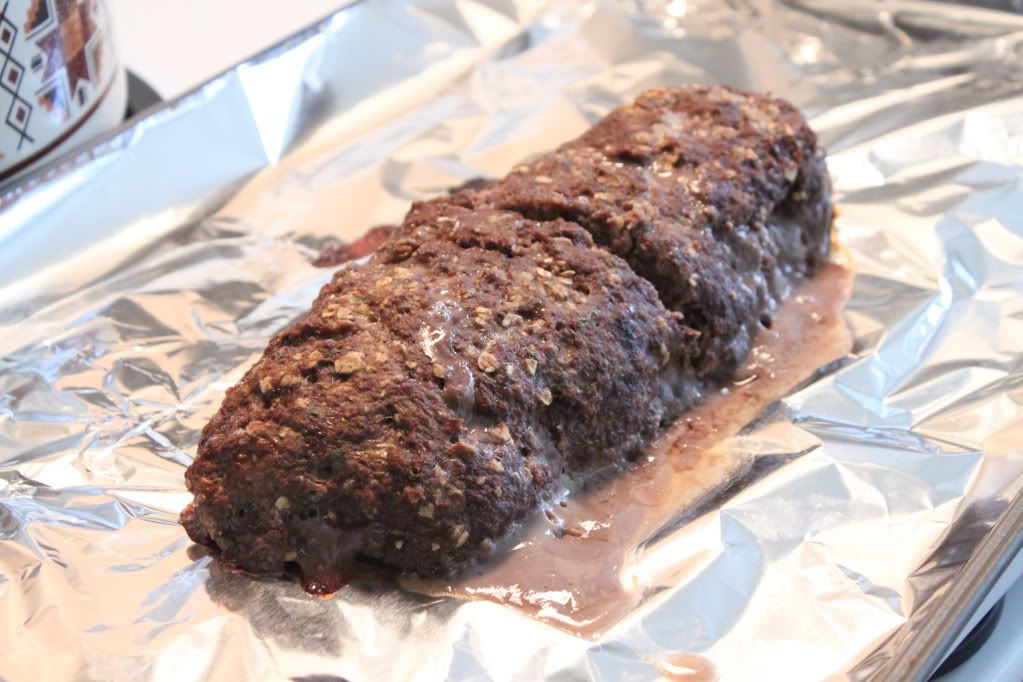
Full of loafy goodness.

I decided to serve this with a spinach salad and a potato-broccoli-cheese concoction. Unfortunately, Google was much less helpful in recommending a wine to go with my exotic dish. Apparently nobody with internet access eats mooseloaf except the Palins. And I imagine they just wash it down with a Big Bear.
In the end I consulted my wine wheel, which recommended Barolo, Barbaresco or Rhone reds for “hoofed animals.” So I went with this, based solely on availability at Liquor Barn:
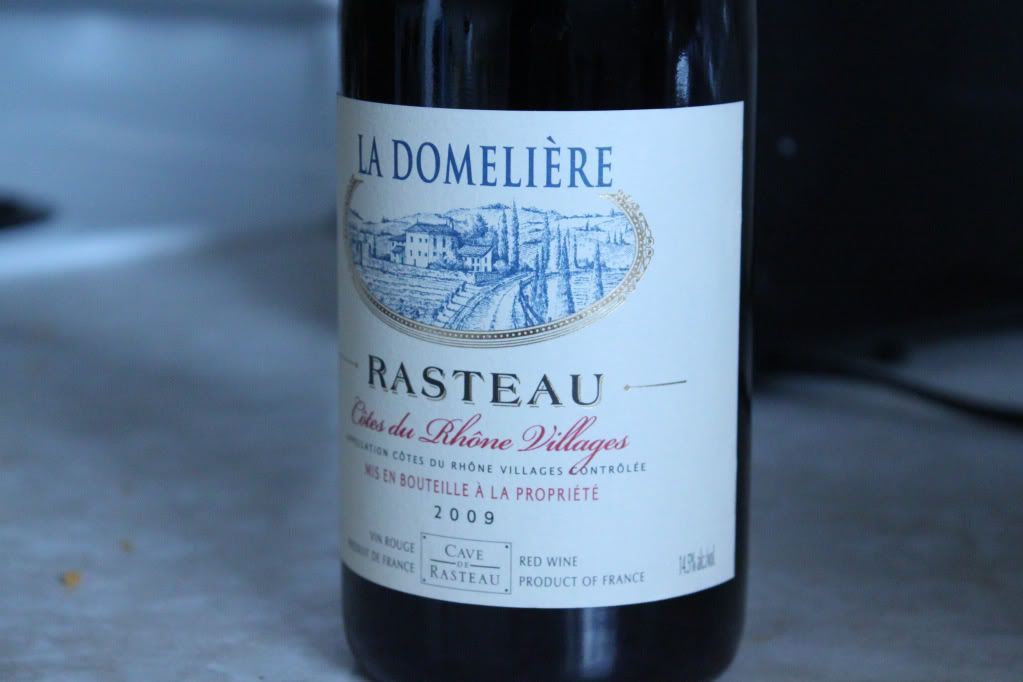
I like how they haven't redesigned their label since woodcuts were the latest technology. So classic.
Finally, tasting time!
It was like the majesty of nature ground up and shaped into a loaf. It wasn’t too gamey thanks to the cumin which “tames the wild flavour,” according to the recipe source.
The verdict: at the risk of sounding barbaric, everyone ought to snare a moose, grind up the carcass and season it with some cumin. Delicious!
So if you needed a reason to take up killing for sport, here it is. No recalls, no e coli, all gamey goodness. 

Thursday, 22 March 2012

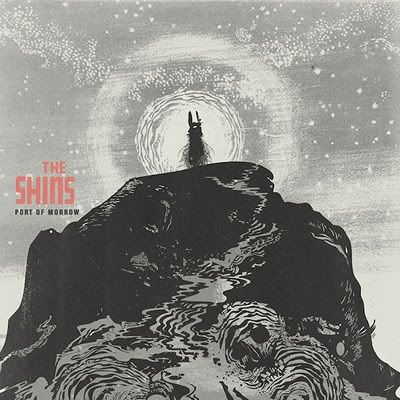
You'll Like What I Tell You To Like: Port Of Morrow

Everyone who has ever written about The Shins references Natalie Portman’s assessment of the band’s music in Garden State—“It will change you life”—and look, I just did too!


But seriously. The Shins changed my life. Wincing the Night Away changed the way I look at music. I loved the melodies, the changing instrumentation, the clever, profound wordplay, James Mercer’s jaded hopefulness, and each album’s natural rise and fall. Oh Inverted World remains at the top of my Desert Island Top Five. 


During the band’s recent five-year hiatus, I came to accept that they would never record as The Shins again. I thought I was able to be satisfied with Broken Bells and the proposition of any other future side project James Mercer may embark upon. 


But then I heard about Port Of Morrow! Like they say, sometimes you don’t know what’s missing until it arrives. Suddenly, I had a new purpose in life: keep breathing until March 20, at which point I could buy the new album. 


When the big day came, I went out and bought Port Of Morrow on my lunch break, planning to listen to it at work that afternoon. When I got back to the office, I unwrapped the CD, untwisted my headphones, and opened the disc drive, but just as I was putting the disc in, I hesitated. 


This was the beginning of a long relationship, I reflected. This album and I could be together for the rest of my life. I thought back over the last five years. Other music had crossed my path, but the three Shins albums—only 32 tracks—were a constant. I always came back to them. They had been the soundtrack to my 20s. 


I knew that in the coming years and decades I would listen to this album dozens or hundreds of time. But I would only listen to it for the first time once. Did I really want it to be here, clandestinely, in dry office air and synthetic fluorescent lighting? 


I replaced the disc in its case and waited. 


When I finally listened to the album hours later, I had mixed feelings. The opener, “The Rifle’s Spiral,” is a strong track—but it could easily be a Broken Bells track, reflecting Mercer’s new infatuation with elaborate production. Like so many tracks on this album, it lacks the innocence that made me fall in love with The Shins. 


Hints of the old Shins appear here and there throughout the album, interspersed with new ideas—some good, some bad. The album has its standout tracks—namely “Bait and Switch,” “Fall of ’82,” and the lead single “Simple Song,” a deceptively complex tune that grows and evolves, well-placed near the beginning of the disc. 


The ballad “It’s Only Life” doesn’t seem to have a place in the Shins catalogue at all. Mercer’s unique voice keeps it from becoming pop drivel, but the easy melody and somewhat clichéd lyrics were a little disappointing. Fortunately “For A Fool” capably fills the album’s ballad quota, with gentle jangly indie guitar work and painful revelations: “Taken for a fool,” Mercer laments, “Yes I was, and I was a fool." 


The album’s biggest disappointment was the closer and title track, which left me feeling unsettled and bewildered, unlike the closers of previous albums. “The Past and Pending” from Oh Inverted World, and “A Comet Appears” from Wincing the Night Away are both such soothing tracks—slow moving, ethereal imagery, a total lack of percussion—that they give the safe sensation of being rocked gently to sleep. 


I suppose that objectively speaking, this is a good album. But as with so many things in life, it was tainted by my high expectations. I guess I was hoping that when I listened to it, I would miraculously be 22 again, with all the bright-eyed bushy-tailed-ness that goes with the territory. I wasn’t. 


But if I’ve lost some of the idealism and newness that first attracted me to the Shins, I’ve at least gained enough wealth to travel across the continent to see the band live! 


This is not my favourite Shins album, but like you still love your least favourite child, I still have a soft spot in my heart for Port Of Morrow.

Thursday, 15 March 2012

The Spark of Life

In one of my creative writing classes in college, we would do a writing assignment each week, then spend part of the next class workshopping it with an assigned group. As the semester wore on, a trend began to develop in my work.

In almost every piece I wrote in that class, someone died, or came close to dying, or in some way flirted with the other side. In increasingly graphic ways. Why is that? I’m not a particularly morbid person.

The fascinating thing about death is how close we are to it at every moment. A step off a curb, a twitch of a steering wheel, a usually-benign crazy guy on the bus—that’s all it takes to send us from one world to the next.

Most people spend their whole lives trying to avoid death. For most of human history that was all life was. Nowadays with the convenience of Safeway and universal health care it doesn’t require the same exertion just to make it to tomorrow, but avoiding death still takes a lot of energy. People build their lives around postponing the inevitable: exercising, wearing a seatbelt, taking swimming lessons. But postpone it all you want—one day, it’s still coming.

I’ve only seen one dead body in my life—it was my great aunt. She had an open casket at her funeral, and I had just turned 15. It was a little scary, but also uncanny. Freud defines the uncanny as that which is familiar, yet somehow not, and that’s what she was. She looked the same—maybe a little greyer—but at the same time, she was just, not.

So, what is that thing that makes the dead not alive? Aside from a pulse and brain activity. Is that all there is to life?

And that, my friends, is why people die in my stories. It’s not because that’s all that happens in life, or because it’s all I can think about—it’s because I want to understand life, and the fine line between the two. Either that or I’m just strapped for ideas.

Monday, 12 March 2012

Spring Sprang Sprung


Edmonton’s long journey towards summer has begun.

Every year we’re subjected to an on-again, off-again, Rachel-and-Ross-esque excuse for a spring. The thermometer will top out at 13 degrees one day (like it did last Friday), only to plunge us into a snowy blender the next.

We’re on the tail end of the mildest winter I can remember—probably the mildest winter that most Edmontonians can remember. And while I do worry about the state of the polar ice caps and the effect this so-called global warming has on them, it was a nice reprieve from the heinous hag that is our usual November-to-May deep freeze.

Observe:

March 2011

March 2012

See the subtle but unmistakeable difference?

This winter, it was really nice to be able to wait five minutes for the bus without having to worry about losing digits. And it was nice to move from point A to point B with minimal trudging. That’s what I really hate about winter—the trudging. The word, so close to “drudgery,” is entirely phonetically apt for describing the action: moving at glacial speed through knee-high drifts, on unshoveled sidewalks, wearing ugly, ugly winter boots, and wrapped so tightly in scarves and toques I can barely turn my head.

Of course, winter does have its charms—namely, the time you don’t spend in it. Finally making it inside, turning on the space heater, brewing tea, watching the storm rage outside. Even better, the winter getaway—that one week per year that Canadians love so much they continue to risk getting shanked in Mexico to enjoy it.

Many people find the topic boring, inane or unbearably safe, but I really love talking about the weather. It’s constant, but always changing, and it’s something we all share. I could spend hours on the topic.

It must be my agrarian roots.

Tuesday, 6 March 2012

You'll Like What I Tell You to Like: The Hunger Games


I just finished The Hunger Games.


As much as I don’t like to buy into trends, sometimes things are popular with good reason. Like legwarmers, and Justin Bieber. And even though not jumping on the bandwagon is all the rage (see the irony?) some trends must be indulged. Sometimes popular books and movies deserve the attention they receive. 

The Hunger Games takes place in a sinister dystopian future. Each year teenagers are selected to participate in a brutal, Darwinian fight to the death. It’s like Extreme Survivor—there’s even a Jeff Probst-esque host.

The text could be saying any number of things about western culture—violence as entertainment, total disregard for privacy, the superficiality of everything, taking wealth for granted while others starve right next door—but the thing that keeps the reader hooked is the page-turning story. Will the main characters live or die? It’s pretty much the most gripping question of all.

But when you've closed the book, what you'll best remember about The Hunger Games is the oft-uncomfortable glimpse it gives into your own mind. What would you do if you found yourself in a position where you had to kill or be killed? How much control do you have over your own id?

I think that in that kind of life-or-death situation you never know what you’ll do until you’re actually faced with such a choice, but at times I felt that I would show far less mercy than Katniss. I expect I’d perch in a tree, out of sight and wait for the other players to kill each other off. But if the opportunity arose to do away with a competitor without danger to myself, getting myself that much closer to safety… well, it would be hard not to take that opportunity.

Saturday, 3 March 2012

A Sweater is Better in Blue

As we all know, blogging is no longer new. So many people blog nowadays that the practice has lost most of its edge, its relevance, its uniqueness.

Still, the medium continues to grow. People blog for many reasons – boredom, networking, insatiable need for attention, passion for a particular topic, or (gasp) actually having something to say.

In my case, it’s to reclaim an identity. I write for a living, in a corporate environment. Everything I write must pass the scrutiny of three or four people, each of whom has their own agenda, quirks, preferences, etc. As a result, the end product usually bears very little resemblance to what originally came out of my brain.

So, in reaction, I want to write something that is mine. I’ve been writing practically since I could hold a pen. I spent years in school honing my craft. I want credit, and I want my real voice to be heard.

I certainly have a theme going.


And so – The Blue Sweater Blog was born! The idea for its name came from my friend and prolific blogger/knitter/generally impressive person Laurie Callsen several years ago. At the time we worked together on our university’s student paper. Since that time, Laurie has become an accomplished multi-media journalist. Check her blog out at www.retro-reporter.com, and you will have little doubt in your mind that I learned from the very best.

At any rate, Laurie noticed I had a lot of sweaters. Blue ones. She suggested that would be a good name for a blog, and given her credentials, who was I to argue?

So here it is—that vision made tangible, with additional help from two other friends – Carrie (www.advantageofdoing.blogspot.com), who recently pointed out the additional networking benefits of blogging, and Beth (www.sparkshalo2.blogspot.com), who created the visual identity for The Blue Sweater Blog.

I don’t have a particular theme or topic in mind for this blog. Basically, it’s just to remind me that there is a world outside of my office, and my words have a place in it.

Thanks for reading. You follow me, I’ll follow you! That’s how these things work.