Saturday, 21 April 2012

On Wine


There was a time when I chose wine based on two things: price, and the level of hilarity represented by the label.

Sometimes I still regress to that point. I bought this just two weeks ago:
Only $12! 
But as a sophisticated woman of the world, and one who now proudly owns a copy of Wine for Dummies, I’m working on developing a taste and knowledge of wine. Words like “bouquet,” “tannins” and “palate” are working their way into my lexicon. One day I feel I’ll be able to discuss a bottle with equally pretentious people without adopting an affected English accent and donning an imaginary monocle.

Beyond its taste and intoxicating quality, here are three things I love about wine:
-       it’s historical
-       it’s international
-       it allows me to turn drinking into a hobby
I love history, I love travel, and I love spending my days in a nauseous haze. I’ve found my true passion in life.

1. Historical
Wine is one of the world’s oldest beverages. At certain times and places throughout history it has even been more popular than water—such as in the margin of time after we developed the technology to pollute our waterways with sewage, but hadn’t yet developed the means to render that same water palatable.

Like really old buildings or really old people, wine has remained constant while everything around it has changed. Certainly wine production has evolved over time, but the basic operation, particularly in many old-world wineries, has been handed down from generation to generation independent of development outside the vineyard walls.

Leonardo da Vinci drank wine. Machiavelli drank wine. Mussolini drank wine. I drink wine! It provides a connection with the past that Pepsi Next lacks.

2. International
Wine is made all over the world. Strangely enough, even before I was interested in wine, I’ve found myself drawn to countries where wine is prominent—Italy, France, Germany and Greece to name a few. What a happy coincidence! My affection for Baroque architecture and my sparse knowledge of French dovetail nicely with this new interest.

I actually visited a winery a number of years ago on a tour of Greece, long before I had any taste for wine whatsoever. It was very scenic; as I recall I nearly crashed a wedding as I was trying to get a picture of the view. As far as the wine itself goes, I don’t remember much about it besides the fact that I didn’t like it, and one was made from oranges. Although maybe the fact that I don’t remember it actually recommends it; we did do a tasting.
A view worth ruining anyone's special day for.


I figured while I was there I might as well paparazzo them. Nothing but class.

Last summer Mitch and I visited the Okanagan, launching my true interest in wine, perhaps in efforts to reconnect with that carefree vacation lifestyle. The pace in the Okanagan is nothing like the pace in Edmonton… it might have something to do with the sheer amount of energy required to stay alive there, i.e. not much, in contrast to here in Edmonton (see this post).
Elephant Island winery, Naramata, BC. Pleasant.
Edmonton, AB. Unpleasant.

Wine represents a way of life that is different from my way of life. It represents a life that is full of pleasure, not one that is spent trudging to work at a utility company each day, as the snow piles ever higher.

3. As for calling drinking a hobby… well, it's nice to have an excuse for these:


So, in summary, a glass of wine can be an escape into a different time, a different place, a different level of consciousness. Drink up!

Sunday, 15 April 2012

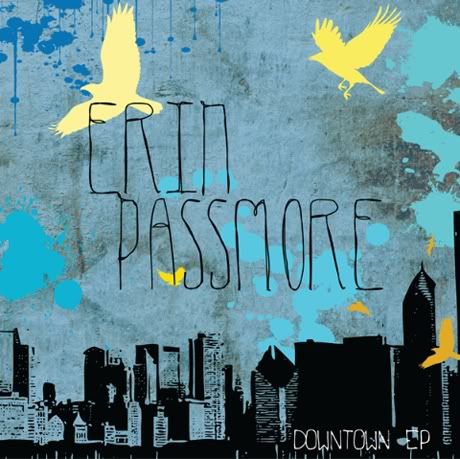
You'll Like What I Tell You to Like: Downtown EP


Some years ago I downloaded a free iTunes single by a little-known band from the Queen City called Rah Rah. The song was “Duet for Emmylou and the Grievous Angel.”

“Wow,” said I. Very little music has had the immediate impact on me like that track did. There was so much I liked about it: the six-eight lilt, the fact that they reference Regina (I was born in a town two hours down the trans-Canada; I can practically see the city from my backyard), the plaintive fiddle work, and most of all, the gentle croon of Erin Passmore.

I later picked up the album, Going Steady, and was suitably impressed. I had only one beef with that album, and with the band’s follow-up, Breaking Hearts: there wasn’t enough Erin.

I’m ashamed to say I’ve never seen the band live, but from what I’ve read, Passmore, who also serves as the band’s drummer, prefers to minimize the time she spends in the spotlight. She steps out from behind the drums just once per set—for “Grievous Angel.” And you can hear the modesty in her voice. It’s a subtle sort of greatness, unwilling to call too much attention to itself.

So imagine my delight when I heard about Downtown EP—all Erin, all the time! With eight tracks all to herself, there was room for Passmore to better explore her musical capacity.
It turns out that Passmore is a multi-instrumentalist and a very capable songwriter, but the thing that still gets me is her voice: it’s gentle as a cooing dove on a strong sedative, but just as you’re being lulled to sleep a her powerful high register will blast you from your reverie like a very melodious alarm clock.

The opening track, “Into the Woods,” is arresting, and it’s everything I love about Passmore. It has the melody and rich instrumentation of Rah Rah (I also read that several of the band’s musicians helped her out on the record), but with a more ominous mood. The title itself conjures up visions of Red Riding Hood venturing into the dark unknown.

“Downtown” is the most upbeat track on the album, and the most surprising: the distorted guitar-driven instrumentation is at odds with Passmore’s vocals, but it’s a successful effort. No track blends into the next—whether it be an aching ode to a love that can never be (“Married”) or a should-I-shouldn’t-I lounge ballad on a friend that could be more (“Rock the Boat”), Passmore tackles even stock subject matter with an earnestness that makes it much more than a pop song.

But the momentum wanes in the second half of the EP. If I’d bought the vinyl instead of the digital album I probably would have worn out side one while rarely even listening to side two. It’s not that the final four tracks are bad; I’m just an instant-gratification type of person. “Monster” has a fun picking pattern and folky feel, but “Fall,” “Sad Song” and “Captain” kind of meld together in a slippery slope of unhappiness.

But at least this depressing turn makes me eager to return to the beginning of the album for a second listen. There’s still some hope there.

Monday, 9 April 2012

Because the World Needs Another Person Who Won’t Shut Up About Their Pets

To celebrate this long weekend, I headed back to Saskatchewan to spend some time with my family.


My parents have two dogs, a white mutt named Charlie and a grey cockapoo (that’s a cocker spaniel/poodle cross) named Bailey. Here they are:
The distribution of focus in this photo roughly equals the distribution of my love.
There wasn’t a whole lot to do this weekend so I spent a considerable portion of it lying on the floor with my camera trying to capture their canine cuteness.
Polite befuddlement!
Chin rubs are more rewarding when you have to work for them.
Look at all that majesty.
Bailey and I later set out for a game of ball. I brought along my camera, still searching for the perfect action shot that eluded me at roller derby.

Bailey's tongue in mid-flap, frozen for all eternity.
I pressed the shutter a micro-second too early here--she's about to launch into a mid-air catch. This is also a good shot of Bailey. :)

If you ignore the overexposure, this was probably the most successful shot. It really captures Bailey's passion for her sport.
An appropriately lazy post for a lazy weekend. Hope you all had an enjoyable Easter!

Wednesday, 4 April 2012

Derbytown


Last weekend I took in some derby.

Roller derby is a decades-old combination of sport and spectacle that has been resurfacing in the last decade. Participants in the event I attended were just little girls, aged about 10-17, and my God. They are already far tougher than I will ever be. 
I saw her kill a puppy.
For the event we headed up to exotic North Edmonton—where we don’t need trash cans, we’ve got bushes! The track is in a small arena on an old army garrison. It smelled like feet.

That may be due to all the roller skates or just a carryover from army days, but it took awhile to get used to. Our seats were in the front row, right on the track—it’s called “suicide row,” due to the number of times spectators there are victims of plays gone awry on the track.

Exhibit A.
The rules of roller derby are complex, but for those who are unfamiliar with it, it involves two teams of girls—the “pack”—skating around an oval track on roller skates. Each team has a “jammer,” who skates around trying to overtake the pack. Every time she laps the pack, the jammer earns a point for her team.

But that description eliminates the real point of the sport: the bruising. This is where the “spectacle” portion of the event comes into play: girls in fishnets and fake eyelashes doing whatever they can to edge each other off the track.

A lot of newbies were participating in the first game of the evening—ten-year-olds who could barely stay upright—so there was little real action. The second game featured older and more experienced players, so the claws came out a little more. As I understand it, the adult league can lead to such injuries as broken legs and dislocated shoulders, so I’m hoping to take my camera to one of those matches sometime to get a few shots of these graceful swans flying into the sidelines.

Not that I’m pro-violence or anything, but I bet these are some of the toughest gals around. I didn’t see a single tear all night, even among the tiniest, most novice players—and there were a few nasty spills. 
The team that gets concussed together, stays together.
Initially I wasn’t sure about how I felt seeing little girls dressed up in fishnets and short shorts and whaling on each other. But after watching the games, and watching the teams interact with each other, I’ve decided the whole movement in its modern incarnation is about liberation. It’s much more “take that” than “look at me.”

It was a great way to spend a Saturday night—even if my hair smelled like moldy socks till the next day. And roller derby can spawn a great point of discussion over beers with your friends afterward: what would your derby name be? Each player adopts a derby name and persona (to distance oneself from the violence? I’m sure studies have been done on this) suggesting the kind of discomfort they’re able to inflict on other players. “Banana Bomb” and “Kat-astrophe” were examples, along with the more explicit “Miss Pain.”

“Piston” was the idea that immediately came to mind for myself, but I feel that with some thought I could do better than that. Mitch suggested “Whore-phine,” like “morphine”—something you’ll need after a match—but maybe it could be made a little more menacing—consider “WhoreFiend.” The possibilities!

I took my camera and spent the evening trying to get a sweet action shot with a jammer in the foreground and the slightly out-of-focus pack in the background. As you can see, I was not successful, but you know, practice, whatever. Check out my quasi-successes below!
Hip dislocation. It's a derby thing.
A triumph of panning!
In which I get artistic.
Evolution: From upright to flat on your ass.
Just as an aside... what does the law say about taking pictures of minors without their parents' permission and posting them on the internet?


Monday, 26 March 2012

Mooseloaf!


Given all the beef recalls we Canadians are currently subject to, I thought I’d play it safe last night. I whipped up a loaf made from the ground carcass of an entirely different animal.


As a child, meatloaf was the only food I ate with ketchup. As a rule I didn’t like either, but I forced them down together hoping that these two culinary wrongs would somehow make a right. They didn’t.

Nevertheless, now I’m older, wiser and cheaper, and I’ve had this free ground moosemeat sitting in my fridge for the last couple of months. I figure serving meat in a loaf is possibly the best way to appreciate all its carcinogenic goodness, so read on and enjoy!


I found a recipe the way anybody finds anything nowadays—through Google. One turned up on a Norwegian blog, as follows:


500 g ground moose meat
50 ml oats
100 ml cream
½ tablespoon potato starch
1 egg, beaten
1 tsp salt
½ tsp black pepper
1 ½ tsp ground cumin
1 garlic clove, pressed
2 Tbsp parsley, finely chopped


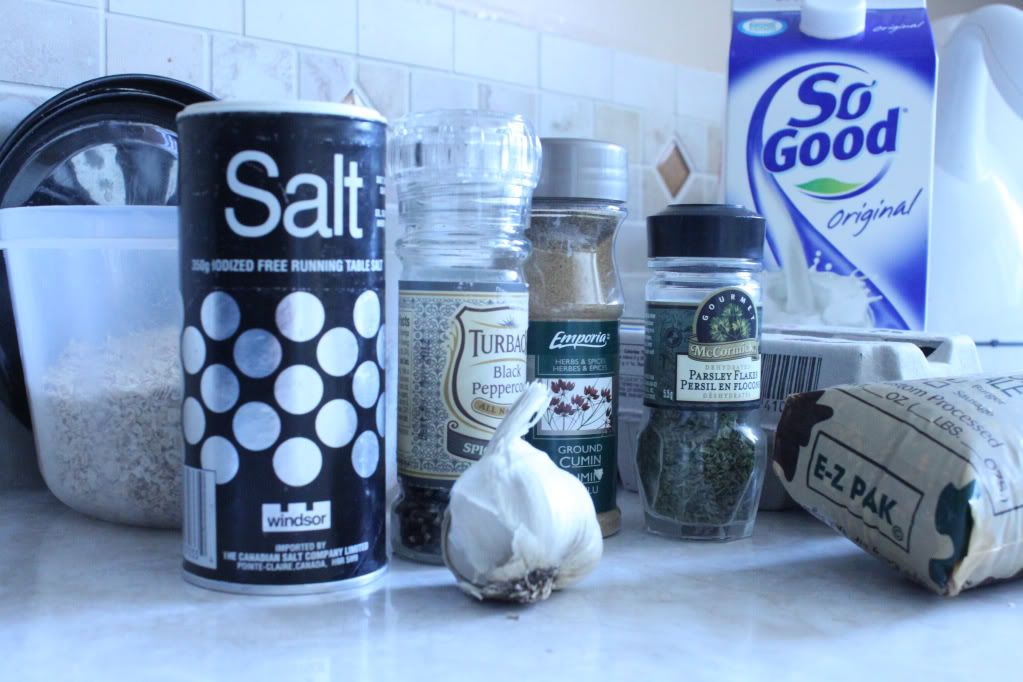
I replaced the cream with soy milk and the potato starch with nothing, seeing as I’ve never heard of it. I’m also not exactly sure how much meat I used—I held the meat in one hand and a 500 g bag of asparagus in the other, with roughly equal muscle strain in both arms, so there you go. The metric-to-imperial conversions were also approximate, but if you prefer a more scientific method you can do your own calculations here.


Now – it’s time to make some moose!

Here's what you'll need.
Step 1. In a large bowl, lightly beat the egg. Add everything except for the ground meat.

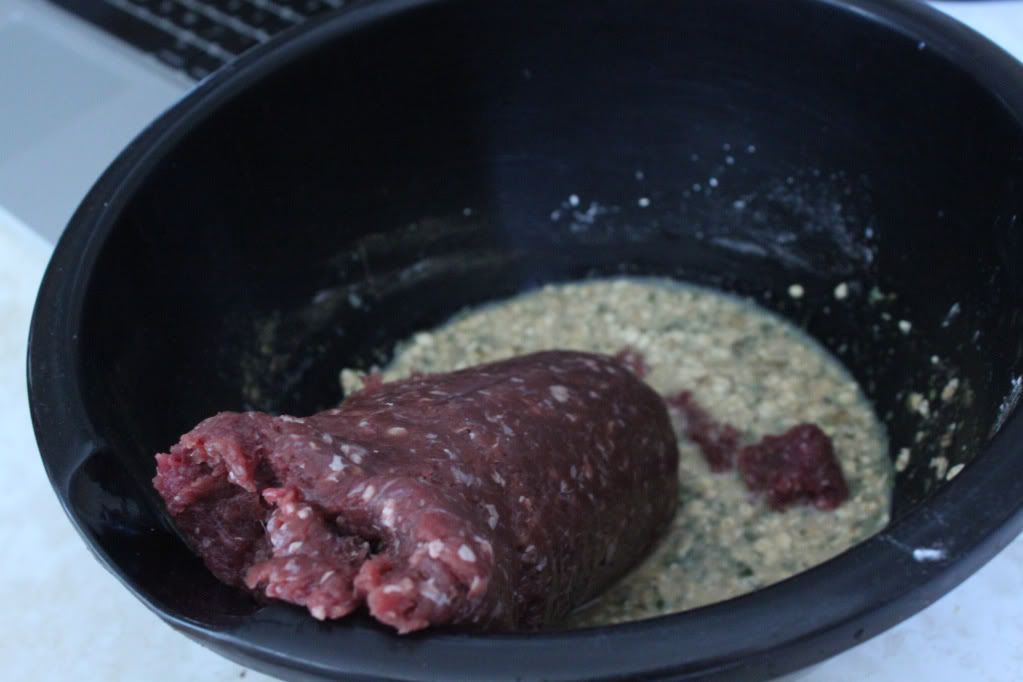
Step 2. Set aside for 5 minutes, then add ground meat and mix well.
Mmmmm.
Step 3. Shape into a "loaf" shape.


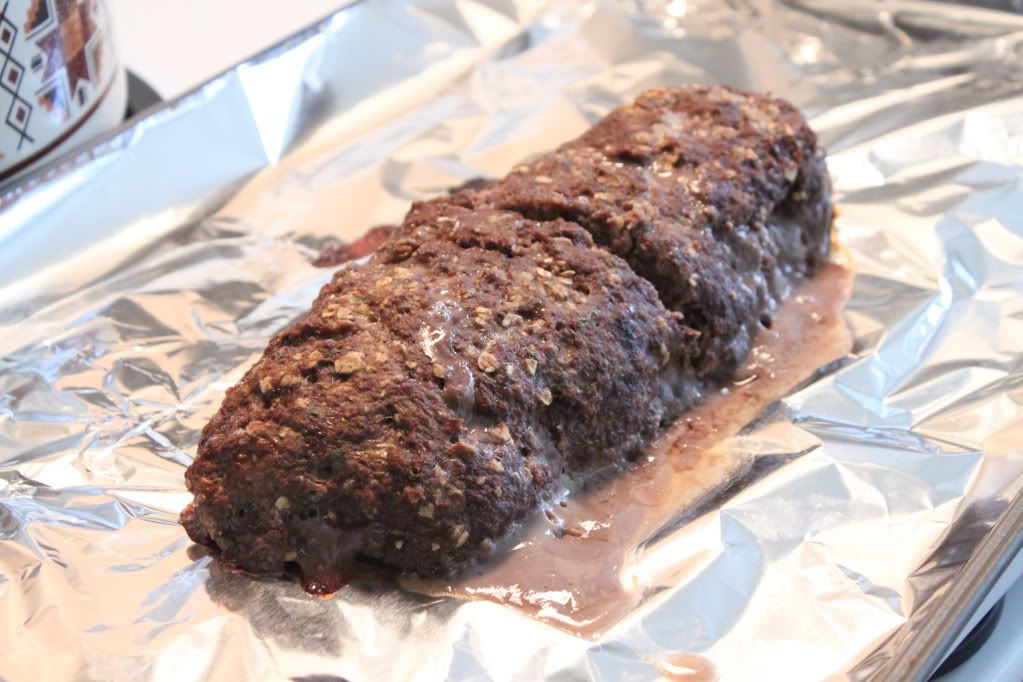
Step 4. Bake on parchment paper [I used foil] lined baking sheet at 225°C [440°F] for about 30 - 40 minutes, or until juices run clear. [I’m paranoid about raw meat and I still took it out of the oven at 30 minutes].
Full of loafy goodness.

I decided to serve this with a spinach salad and a potato-broccoli-cheese concoction. Unfortunately, Google was much less helpful in recommending a wine to go with my exotic dish. Apparently nobody with internet access eats mooseloaf except the Palins. And I imagine they just wash it down with a Big Bear.
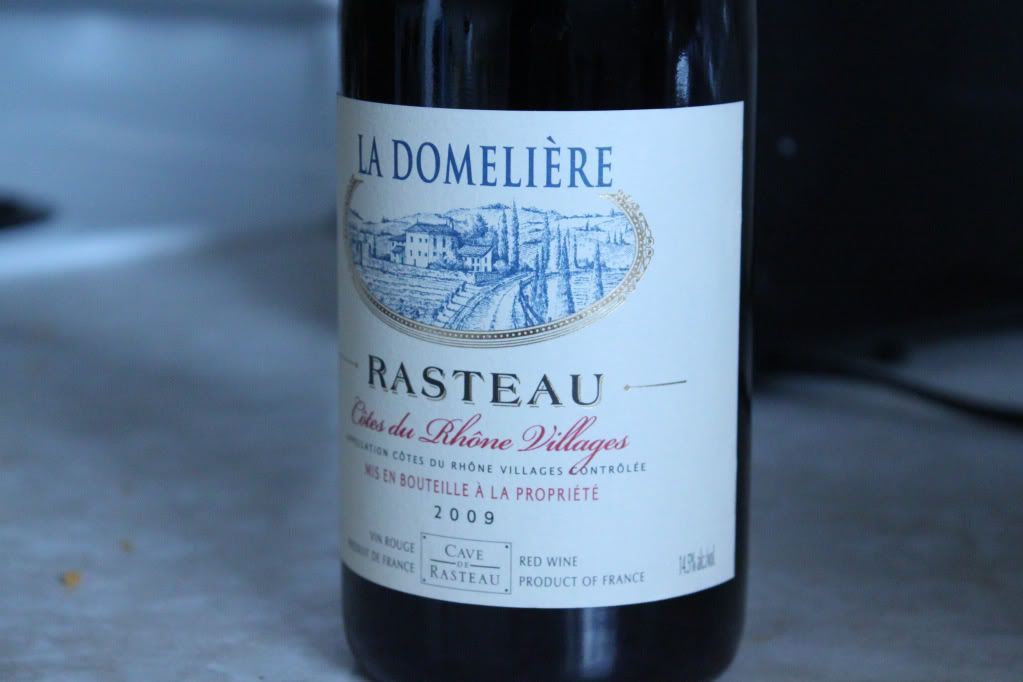
In the end I consulted my wine wheel, which recommended Barolo, Barbaresco or Rhone reds for “hoofed animals.” So I went with this, based solely on availability at Liquor Barn:
I like how they haven't redesigned their label since woodcuts were the latest technology. So classic.
Finally, tasting time!
It was like the majesty of nature ground up and shaped into a loaf. It wasn’t too gamey thanks to the cumin which “tames the wild flavour,” according to the recipe source.
The verdict: at the risk of sounding barbaric, everyone ought to snare a moose, grind up the carcass and season it with some cumin. Delicious!
So if you needed a reason to take up killing for sport, here it is. No recalls, no e coli, all gamey goodness. 

Thursday, 22 March 2012

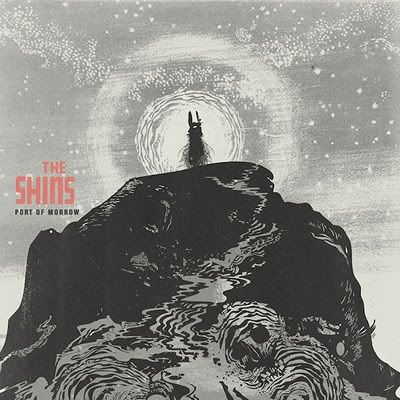
You'll Like What I Tell You To Like: Port Of Morrow

Everyone who has ever written about The Shins references Natalie Portman’s assessment of the band’s music in Garden State—“It will change you life”—and look, I just did too!


But seriously. The Shins changed my life. Wincing the Night Away changed the way I look at music. I loved the melodies, the changing instrumentation, the clever, profound wordplay, James Mercer’s jaded hopefulness, and each album’s natural rise and fall. Oh Inverted World remains at the top of my Desert Island Top Five. 


During the band’s recent five-year hiatus, I came to accept that they would never record as The Shins again. I thought I was able to be satisfied with Broken Bells and the proposition of any other future side project James Mercer may embark upon. 


But then I heard about Port Of Morrow! Like they say, sometimes you don’t know what’s missing until it arrives. Suddenly, I had a new purpose in life: keep breathing until March 20, at which point I could buy the new album. 


When the big day came, I went out and bought Port Of Morrow on my lunch break, planning to listen to it at work that afternoon. When I got back to the office, I unwrapped the CD, untwisted my headphones, and opened the disc drive, but just as I was putting the disc in, I hesitated. 


This was the beginning of a long relationship, I reflected. This album and I could be together for the rest of my life. I thought back over the last five years. Other music had crossed my path, but the three Shins albums—only 32 tracks—were a constant. I always came back to them. They had been the soundtrack to my 20s. 


I knew that in the coming years and decades I would listen to this album dozens or hundreds of time. But I would only listen to it for the first time once. Did I really want it to be here, clandestinely, in dry office air and synthetic fluorescent lighting? 


I replaced the disc in its case and waited. 


When I finally listened to the album hours later, I had mixed feelings. The opener, “The Rifle’s Spiral,” is a strong track—but it could easily be a Broken Bells track, reflecting Mercer’s new infatuation with elaborate production. Like so many tracks on this album, it lacks the innocence that made me fall in love with The Shins. 


Hints of the old Shins appear here and there throughout the album, interspersed with new ideas—some good, some bad. The album has its standout tracks—namely “Bait and Switch,” “Fall of ’82,” and the lead single “Simple Song,” a deceptively complex tune that grows and evolves, well-placed near the beginning of the disc. 


The ballad “It’s Only Life” doesn’t seem to have a place in the Shins catalogue at all. Mercer’s unique voice keeps it from becoming pop drivel, but the easy melody and somewhat clichéd lyrics were a little disappointing. Fortunately “For A Fool” capably fills the album’s ballad quota, with gentle jangly indie guitar work and painful revelations: “Taken for a fool,” Mercer laments, “Yes I was, and I was a fool." 


The album’s biggest disappointment was the closer and title track, which left me feeling unsettled and bewildered, unlike the closers of previous albums. “The Past and Pending” from Oh Inverted World, and “A Comet Appears” from Wincing the Night Away are both such soothing tracks—slow moving, ethereal imagery, a total lack of percussion—that they give the safe sensation of being rocked gently to sleep. 


I suppose that objectively speaking, this is a good album. But as with so many things in life, it was tainted by my high expectations. I guess I was hoping that when I listened to it, I would miraculously be 22 again, with all the bright-eyed bushy-tailed-ness that goes with the territory. I wasn’t. 


But if I’ve lost some of the idealism and newness that first attracted me to the Shins, I’ve at least gained enough wealth to travel across the continent to see the band live! 


This is not my favourite Shins album, but like you still love your least favourite child, I still have a soft spot in my heart for Port Of Morrow.

Thursday, 15 March 2012

The Spark of Life

In one of my creative writing classes in college, we would do a writing assignment each week, then spend part of the next class workshopping it with an assigned group. As the semester wore on, a trend began to develop in my work.

In almost every piece I wrote in that class, someone died, or came close to dying, or in some way flirted with the other side. In increasingly graphic ways. Why is that? I’m not a particularly morbid person.

The fascinating thing about death is how close we are to it at every moment. A step off a curb, a twitch of a steering wheel, a usually-benign crazy guy on the bus—that’s all it takes to send us from one world to the next.

Most people spend their whole lives trying to avoid death. For most of human history that was all life was. Nowadays with the convenience of Safeway and universal health care it doesn’t require the same exertion just to make it to tomorrow, but avoiding death still takes a lot of energy. People build their lives around postponing the inevitable: exercising, wearing a seatbelt, taking swimming lessons. But postpone it all you want—one day, it’s still coming.

I’ve only seen one dead body in my life—it was my great aunt. She had an open casket at her funeral, and I had just turned 15. It was a little scary, but also uncanny. Freud defines the uncanny as that which is familiar, yet somehow not, and that’s what she was. She looked the same—maybe a little greyer—but at the same time, she was just, not.

So, what is that thing that makes the dead not alive? Aside from a pulse and brain activity. Is that all there is to life?

And that, my friends, is why people die in my stories. It’s not because that’s all that happens in life, or because it’s all I can think about—it’s because I want to understand life, and the fine line between the two. Either that or I’m just strapped for ideas.